
Ger types
Original Mongolian Yurts
Yurt Types
The yurts we supply can be placed into three categories with regard to the degree of craftsmanship with which their wooden frames are made. The types are
a.Carved yurt
b.Decorative yurt
Decorative
: The rafters, crown, door, and central columns (pillars) of this yurt are painted with traditional decorative patterns. Decorative yurts come in a variety of sizes, denoted by the number of folding wall segments used in their construction. Yurts of four, five, six, eight, and ten wall segments are available; while yurts of this type with more than ten wall segments can be made to order


Carved
. The rafters, crown, door, and central columns (pillars) of this yurt are carved with traditional decorative patterns. This carving involves painstaking work, a high level of creativity and great skill, making carved yurts more expensive than decorative ones and relatively rare even in Mongolia. Our carved yurts are the work of the most skilled of Mongolian carpenters working in an ancient tradition. Carved yurts can be provided in sizes of four, five, six, eight, and ten wall segment

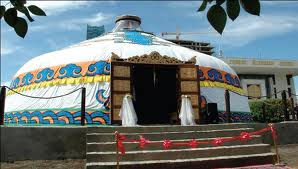

The Material for a Yurt
The structure of a yurt consists of a number of wooden parts (numbers for a standard sized yurt):
-
5 latice wall segments (khana)
-
A door (khaalga) in a frame
-
88 roof poles (uni).
-
A crown (toono) as hub for the roof poles.
-
Two columns (bagana) to support the crown.
-
For a stationary yurt a wooden floor (shal) of 9 elements.
The hull and interior lining consists of several textile parts.
-
Curtains (khöshig) from colored cotton, 3 parts.
-
Roof lining (dotuur burees) from white cotton.
-
Layer of wool felt (esgii), in three sections on the roof and four sections around the walls.
-
Waterproof canvas or synthetic cover (brezent), in two sections.
-
Exterior cover (gaduur burees) from white cotton, with blue patterns applied around crown and door.
-
Cover for the crown (örkh) with four ropes, waterproof with felt insulation in winter.
-
Straps, ropes (goshlon) and strings (ujas), to connect the various elements


